Have you ever glanced at the clock and wondered, “how long until 3:25?” You’re not alone. This exact question gets typed into search bars every single day, usually by someone waiting for a meeting to end, a school bell to ring, or the workday to wrap up. The good news is that figuring out the time remaining doesn’t require a calculator or a countdown app. It just takes a little bit of clock math, and once you know the trick, you’ll never struggle with it again.
This guide breaks down the fastest way to calculate time until 3:25, explains why the base 60 system makes clock math tricky, and shows you exactly how the numbers change depending on your starting point.
Quick Answer Summary
| Current Time | Time Until 3:25 PM | Time Until 3:25 AM |
| 12:00 PM | 3 hours 25 minutes | 15 hours 25 minutes |
| 1:00 PM | 2 hours 25 minutes | 14 hours 25 minutes |
| 2:00 PM | 1 hour 25 minutes | 13 hours 25 minutes |
| 3:00 PM | 25 minutes | 12 hours 25 minutes |
| 3:15 PM | 10 minutes | 12 hours 10 minutes |
| 3:25 PM | 0 minutes (it’s here) | 12 hours |
These figures are based on a standard 24 hour cycle and assume you’re counting toward the same day unless otherwise noted.
Why People Search “How Long Until 3:25”
This question pops up more often than you’d think, and it usually falls into one of a few categories:
- School pickup times. Many elementary schools dismiss students right around 3:25 PM.
- Stock market countdowns. Traders often track the final stretch before the New York Stock Exchange closes at 4:00 PM, and 3:25 marks a key checkpoint.
- Meeting or appointment deadlines. A call scheduled for 3:25 means someone is watching the clock closely.
- Simple curiosity. Sometimes people just want a quick mental break down of how much of the day is left.
Whatever your reason, the math behind it stays the same.
The Fastest Way to Calculate Time Until 3:25
Subtracting times isn’t like subtracting regular numbers. You can’t just do 325 minus your current time the way you would with 100 minus 60, because clocks don’t work in a clean base 10 system. Instead, try the hour jump method. It’s the easiest mental shortcut for this kind of problem.
Step by Step Example
Let’s say it’s currently 1:15 PM, and you want to know how long until 3:25 PM.
- Jump from 1:15 PM to 2:15 PM. That’s one full hour.
- Jump from 2:15 PM to 3:15 PM. That’s a second full hour.
- Now you’re only 10 minutes away from 3:25 PM.
- Add it up: 2 hours plus 10 minutes equals 2 hours and 10 minutes.
Here’s another example. If it’s 1:40 PM, jumping straight to 3:40 PM would overshoot the target, so adjust instead.
- Jump from 1:40 PM to 2:40 PM (one hour).
- From 2:40 PM, count up to 3:00 PM (20 minutes).
- From 3:00 PM, add the last 25 minutes to reach 3:25 PM.
- Total: 1 hour, plus 20 minutes, plus 25 minutes equals 1 hour and 45 minutes.
This method works because it avoids the confusing part of clock math: borrowing across the colon.
Read This: How Long Until 2 PM Today? A Simple, Fast Way to Find Out
Understanding the Base 60 Rule
Most of the confusion around time subtraction comes from one simple fact: there are 60 minutes in an hour, not 100. Our brains are wired for a base 10 system, so when we try to subtract times the way we subtract regular numbers, the math falls apart.
For example, you can’t simply take 3:25 and subtract 1:40 the way you’d subtract 325 from 140. You have to treat the colon as a dividing wall. When the minutes on the bottom number are bigger than the minutes on top, you borrow 60 minutes from the hour column, not 10. This single rule trips up more people than anything else in time calculation, and it’s exactly why shortcuts like the hour jump method exist.
Time Remaining From Different Starting Points
Here’s a broader table for quick reference, covering common times people search around this topic.
| Starting Time | Hours and Minutes Until 3:25 PM |
| 9:00 AM | 6 hours 25 minutes |
| 10:30 AM | 4 hours 55 minutes |
| 12:15 PM | 3 hours 10 minutes |
| 1:50 PM | 1 hour 35 minutes |
| 2:45 PM | 40 minutes |
| 3:10 PM | 15 minutes |
| 3:20 PM | 5 minutes |
Bookmark this table if you find yourself asking this question often, especially around the same time each day.
AM or PM? Why It Matters
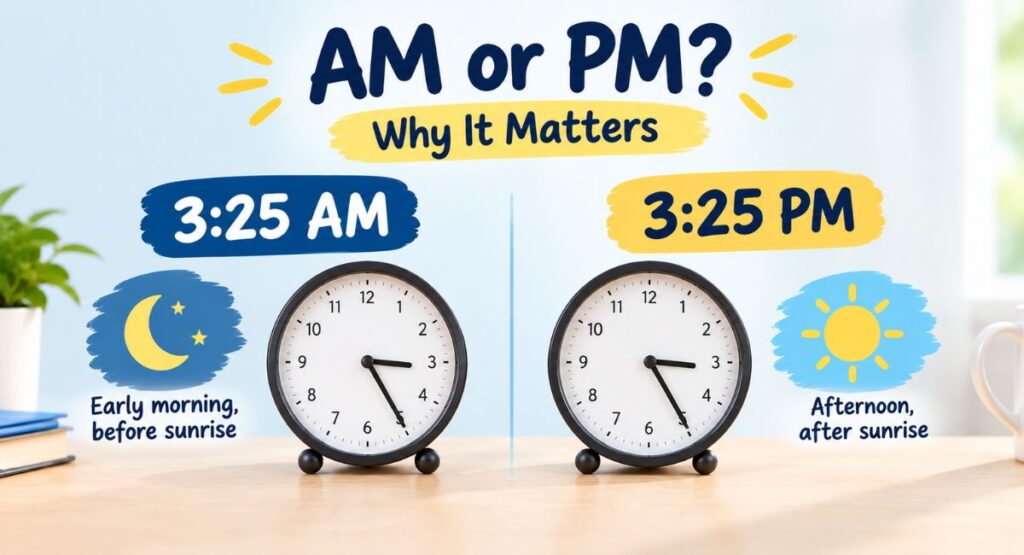
One detail that trips people up is forgetting to specify morning or afternoon. 3:25 AM and 3:25 PM are twelve hours apart, which makes a huge difference depending on your schedule.
- If you’re counting down from a late night, 3:25 AM might be your target.
- If you’re tracking a workday deadline, 3:25 PM is far more common.
- Always double check which one applies before doing the math, especially if you’re setting an alarm.
Tools That Make This Instant
You don’t have to do the math yourself every time. Plenty of built in tools can calculate this for you:
- Search engine quick answers. Typing your question directly into a search bar often returns an instant countdown.
- Phone clock apps. Most smartphones let you set a countdown timer manually.
- Browser countdown extensions. These run quietly in the background and alert you when time is up.
That said, relying on these tools constantly can actually work against you. Watching a countdown tick down in real time tends to make the wait feel longer, not shorter. It’s often better to set a single alarm, put the phone away, and let your attention return to whatever you’re doing.
The Psychology Behind the Wait
Ever notice how time seems to crawl when you’re staring at the clock? That’s a real psychological effect, sometimes called the watched pot phenomenon. When your brain is hyper focused on counting seconds, it becomes over aware of everything around it, which makes the passage of time feel slower.
Interestingly, the mid afternoon hours between roughly 2:00 PM and 4:00 PM also line up with a natural dip in alertness for many people. This is sometimes referred to as the afternoon slump, and it can make waiting for a specific time, like 3:25, feel even more drawn out than it actually is.
The fix is simple: instead of watching the clock, set a single reminder and redirect your focus elsewhere. Your internal sense of time will thank you.
Real Life Situations Where 3:25 Comes Up
- Parents waiting on school buses or pickup lines often treat 3:25 as a soft deadline before the after school rush begins.
- Traders and investors watch this time as a signal that the market’s final 35 minutes are underway.
- Remote workers sometimes use it as a mental marker for wrapping up tasks before the end of the day.
- Students counting down to the final bell often use this exact time as their target.
Recognizing the pattern in your own routine can help you plan around it more naturally instead of constantly checking the clock.
Final Thoughts
Figuring out how long until 3:25 doesn’t need to be complicated. Once you understand the hour jump method and the base 60 rule behind clock math, you can calculate the time remaining in seconds, without needing an app or a calculator.
Whether you’re a parent tracking pickup time, a trader watching the market, or just someone curious about the clock, this simple approach works every time.
Frequently Asked Questions
How do I calculate the time left until 3:25 PM?
Use the hour jump method: count full hours first, then add the remaining minutes separately.
Is 3:25 AM the same as 3:25 PM?
No, they are exactly twelve hours apart, so always confirm which one you mean before setting an alarm.
Why is time math harder than regular subtraction?
Clocks run on a base 60 system, not base 10, so you borrow 60 minutes instead of 10 when subtracting.
What is a fast way to check this without doing math?
Typing the question directly into a search engine usually returns an instant countdown answer.
Why does waiting for a specific time feel so slow?
Constantly checking the clock creates the watched pot effect, making your brain hyper aware of every passing second.

Wellcome to celebbeacon, I am professional content witer with 3 years of experience.