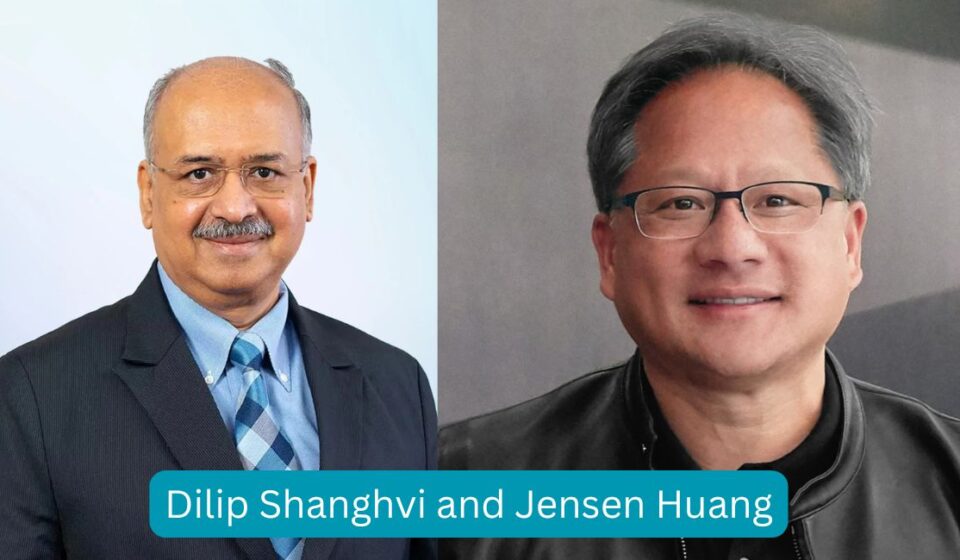

Dilip Shanghvi built India’s largest drugmaker from a $200 loan. Jensen Huang built the world’s most valuable company from a booth at Denny’s. Their industries differ, yet both men started small, committed to one big idea, and stayed patient for decades.
This guide covers their biography, net worth, family life, and careers in one place. Figures come from outlets such as Forbes and Bloomberg and reflect mid October 2026. Billionaire wealth moves daily, so treat every number as a snapshot.
Profile Summary – Dilip Shanghvi and Jensen Huang
| Detail | Dilip Shanghvi | Jensen Huang |
| Full name | Dilip Shantilal Shanghvi | Jensen Huang (birth name Jen Hsun Huang) |
| Age | 71 (born October 1, 1955) | 63 (born February 17, 1963) |
| Birthplace | Amreli, Gujarat, India | Taiwan (sources differ on the city) |
| Height | Not publicly disclosed | Not publicly disclosed |
| Weight | Not publicly disclosed | Not publicly disclosed |
| Spouse | Vibha Shanghvi | Lori Huang (née Mills) |
| Children | Two (Aalok and Vidhi) | Two (Madison and Spencer) |
| Net worth | About $24.6 billion (Forbes, October 14, 2026) | About $199 billion (Forbes, October 8, 2026) |
| Profession | Pharmaceutical entrepreneur | Technology executive and engineer |
| Company | Sun Pharmaceutical Industries | Nvidia |
| Education | Commerce degree, University of Calcutta | BS Oregon State, MS Stanford |
| Social handles | Not publicly disclosed | Not publicly disclosed |
Dilip Shanghvi Biography
Dilip Shanghvi is the Indian billionaire founder of Sun Pharmaceutical Industries, the country’s most valuable listed drugmaker. He is known for quiet leadership and a talent for rescuing troubled companies.
Early Life, Family and Education
Dilip Shanghvi was born on October 1, 1955, in Amreli, Gujarat, and grew up in Kolkata. His father ran a pharmaceutical trading business that sold branded and generic drugs. That early exposure to the drug trade likely shaped his path.
Shanghvi reportedly attended the J.D. Birla Institute before earning a commerce degree from the University of Calcutta. He never trained as a scientist. Instead, he learned medicine from the sales and supply side.
Founding Sun Pharma
Shanghvi founded Sun Pharma in 1983 in Vapi, Gujarat, using roughly ₹10,000 (about $200) borrowed from his father. The company began with a narrow focus on psychiatric medicines. Bloomberg describes the early team as a tiny operation selling a single drug.
Growth came in clear steps:
- 1993: He set up a research center to speed up generic drug development.
- Late 1990s: Sun entered the US market through Detroit based Caraco Pharmaceuticals.
- Later years: He won control of Israel based Taro after a bitter three year fight with its owners.
His formula stayed consistent. Buy an underperforming company, merge its operations into Sun, and fix the economics. Bloomberg counts 13 drugmakers acquired since 1997. Today Sun operates in more than 100 countries with roughly 35,000 employees. Forbes puts annual revenue near $6.1 billion, with about two thirds earned outside India.
The Ranbaxy Turning Point
The Ranbaxy acquisition, valued at about $4 billion, made Sun Pharma the leader of Indian pharma. Announced in 2014 and closed in March 2015, the deal joined two of India’s biggest drug companies. Ranbaxy carried a damaged reputation after quality scandals, so many observers doubted the move.
Shanghvi saw value where others saw baggage. Sun’s stock rose after the deal, and Bloomberg called him the world’s richest pharmaceutical tycoon. It remains the clearest example of his turnaround instinct.
Awards and Public Recognition
Shanghvi’s best known honor is the Padma Shri, awarded by the Government of India in 2016. Other recognitions include:
- EY Entrepreneur of the Year, India in 2005
- India Today ranking as the 8th most powerful Indian in 2017
- Forbes 2026 Billionaires list, where he sits at No. 100
Current Role and Sun Pharma’s Next Chapter
Shanghvi still leads Sun Pharma as chairman and managing director, and the company is chasing its biggest US deal yet. In April 2026, Sun agreed to buy Organon & Co. in a deal valued at $11.8 billion. Forbes says the purchase would more than double annual revenue to $12.4 billion and place Sun among the world’s top 25 drugmakers. Completion is expected in 2027, pending approvals.
Succession is also taking shape. His son Aalok Shanghvi became chief operating officer in February 2025. Sun also bought US skin cancer drugmaker Checkpoint Therapeutics for $355 million in May 2025.
Jensen Huang Biography
Jensen Huang is the Taiwanese American cofounder, president, and CEO of Nvidia, the company at the center of the AI boom. He has led Nvidia since day one, which is rare for a founder of a company this large.
Birth, Childhood and Education
Jensen Huang was born on February 17, 1963, in Taiwan, and spent his early childhood in Taiwan and Thailand. At nine, he moved to the United States with his brother and attended Oneida Baptist Institute in Kentucky. His parents arrived about two years later, and the family settled near Portland, Oregon.
At Aloha High School, Huang played table tennis well enough to earn a national ranking. He also worked at a Denny’s as a teen. He chose Oregon State University partly for its low in state tuition and graduated in 1984 with an electrical engineering degree. He later earned a master’s degree from Stanford University in 1992 through night classes while working at LSI Logic.
Founding NVIDIA in 1993
Huang cofounded Nvidia in 1993, at age 30, from a Denny’s restaurant in San Jose, California. His partners were Chris Malachowsky and Curtis Priem. Before that, Huang worked at LSI Logic and Advanced Micro Devices as a chip designer.
The startup bet on 3D graphics for personal computers. That bet looked risky at the time. It paid off as gaming took off.
From Graphics Chips to the AI Era
Nvidia reached the AI era by turning the GPU into a general purpose engine for parallel computing. The company introduced the GPU in 1999, then opened it to programmers through its CUDA software. Researchers soon discovered those chips trained neural networks far faster than ordinary processors.
The results are hard to ignore:
- Nvidia became the first company valued at $5 trillion and now trades near $6 trillion.
- Huang’s company agreed in September 2026 to buy AI model hub Hugging Face for $12.9 billion.
- About 97% of his wealth reportedly sits in Nvidia shares.
2026 Recognition and Influence
In 2026, Huang received the IEEE Medal of Honor and joined the President’s Council of Advisors on Science and Technology. He also won the Queen Elizabeth Prize for Engineering in 2025. Time named him among its “Architects of AI” for Person of the Year in 2025, and he appeared on the Time 100 list in 2021 and 2024.
Personal Life, Marriage and Family
Both men are married with two children each, and both keep family life mostly private. Each has also brought the next generation into the family business.
Is Dilip Shanghvi Married?
Yes, Dilip Shanghvi is married to Vibha Shanghvi. She rarely appears in public, and the wedding date is not publicly disclosed. The couple has two children: Aalok, now Sun Pharma’s chief operating officer, and Vidhi, who also works at the company.
Is Jensen Huang Married?
Yes, Jensen Huang is married to Lori Huang (née Mills). They met at Oregon State, where Lori was his engineering lab partner. Their two children, Madison and Spencer, both work at Nvidia in product roles.
The couple runs the Jen Hsun and Lori Huang Foundation, which they started in 2007. Notable gifts include $50 million to Oregon State and $30 million to Stanford.
Net Worth and Financial Breakdown
Jensen Huang’s fortune is roughly eight times larger than Dilip Shanghvi’s as of mid October 2026. Both fortunes come almost entirely from one company each.
Dilip Shanghvi Net Worth
Dilip Shanghvi’s net worth is about $24.6 billion, according to Forbes real time data on October 14, 2026. Bloomberg shows a higher figure of $27.9 billion. The gap comes from method. Bloomberg credits him with promoter group shares held by family and trusts, while excluding pledged shares.
Forbes ranks him No. 100 on its 2026 list. Sun Pharma’s market value tops $44 billion, and that stake drives nearly everything he owns. Be careful with low quality sites that print wildly different numbers. Stick with Forbes and Bloomberg.
Jensen Huang Net Worth
Jensen Huang’s net worth is about $199 billion to $203 billion, depending on Nvidia’s share price that day. Forbes put him at $203.2 billion on October 2, 2026, when Nvidia hit a record above $237. By October 8, a 3% stock drop trimmed $6.1 billion and left him at $199.3 billion, seventh on the real time list.
He owns roughly 4% of Nvidia, though some outlets cite 3% to 3.5%. Those swings are paper gains and losses, not cash leaving his pocket.
Selected Verified Wealth Snapshots
The table below shows dated estimates from major trackers.
| Date | Person | Estimate | Source |
| January 12, 2026 | Dilip Shanghvi | $26.3 billion | Forbes real time |
| October 14, 2026 | Dilip Shanghvi | $24.6 billion | Forbes real time |
| 2026 (live index) | Dilip Shanghvi | $27.9 billion | Bloomberg |
| August 27, 2026 | Jensen Huang | $197.6 billion | Forbes |
| October 2, 2026 | Jensen Huang | $203.2 billion | Forbes real time |
| October 8, 2026 | Jensen Huang | $199.3 billion | Forbes |
Career Timeline Comparison
Shanghvi started his company a decade before Huang, though Huang’s company grew far faster. This table puts their milestones side by side.
| Year | Dilip Shanghvi | Jensen Huang |
| 1955 | Born in Amreli, Gujarat | Not yet born |
| 1963 | Still a child in Kolkata | Born in Taiwan |
| 1983 | Founds Sun Pharma in Vapi | Studying engineering in Oregon |
| 1984 | Building a psychiatry portfolio | Earns Oregon State degree |
| 1993 | Opens a research center | Cofounds Nvidia |
| Late 1990s | Enters the US via Caraco | Nvidia introduces the GPU in 1999 |
| 2014 to 2015 | Buys Ranbaxy for about $4 billion | Nvidia rides the deep learning wave |
| 2016 | Receives the Padma Shri | Leads a growing AI chip business |
| 2025 | Son Aalok becomes COO | Wins the Queen Elizabeth Prize |
| 2026 | Agrees to buy Organon | Receives the IEEE Medal of Honor |
Dilip Shanghvi vs. Jensen Huang: What Makes Their Stories Different?
Shanghvi grew by buying and fixing companies, while Huang grew by inventing and building platforms. That single contrast explains most of the gap between them.
| Factor | Dilip Shanghvi | Jensen Huang |
| Industry | Generic and specialty medicine | Chips and AI computing |
| Starting capital | About $200 from his father | A shared booth at Denny’s |
| Growth style | Acquisitions and turnarounds | In house invention |
| Public profile | Low and data driven | High, famous for his leather jacket |
| Wealth in one stock | Sun Pharma | Nvidia |
Still, the two men share traits. Both founded their companies and never left. Both stayed focused on one core field. Both also trusted family and long term thinking over flashy headlines.
Fast Facts: Dilip Shanghvi vs. Jensen Huang
- Shanghvi founded Sun Pharma in 1983 with about $200.
- Huang cofounded Nvidia in 1993 at age 30.
- Shanghvi’s net worth is about $24.6 billion (Forbes).
- Huang’s net worth is about $199 billion to $203 billion (Forbes).
- Sun Pharma bought Ranbaxy for roughly $4 billion.
- Nvidia was the first company valued at $5 trillion.
- Shanghvi received the Padma Shri in 2016.
- Huang received the IEEE Medal of Honor in 2026.
- Both men are married with two children.
- Both have a child working in the family business.
FAQs
Who is richer, Dilip Shanghvi or Jensen Huang?
Jensen Huang is far richer. Forbes estimates about $199 billion for Huang versus about $24.6 billion for Shanghvi.
How old are Dilip Shanghvi and Jensen Huang?
Dilip Shanghvi is 71, born October 1, 1955. Jensen Huang is 63, born February 17, 1963.
How did Dilip Shanghvi start Sun Pharma?
He borrowed about ₹10,000 (roughly $200) from his father in 1983. He then built the company through psychiatric drugs and a long string of acquisitions.
How did Jensen Huang make his fortune?
He cofounded Nvidia in 1993 and still owns roughly 4% of it. Surging demand for AI chips pushed his stake past $190 billion.
Do Dilip Shanghvi and Jensen Huang work together?
No public partnership between them is known. They lead companies in separate industries.
Conclusion
Dilip Shanghvi and Jensen Huang prove that a small start can grow into a global giant. Shanghvi turned a $200 loan into India’s top drugmaker through patient deal making. Huang turned a Denny’s booth into the engine of the AI economy through bold engineering.
Their wealth differs by a wide margin, yet their discipline looks familiar. Each man chose a field, stayed loyal to it, and kept building. Check Forbes and Bloomberg for live figures, since both fortunes rise and fall with their company stock.

Wellcome to celebbeacon, I am professional content witer with 3 years of experience.