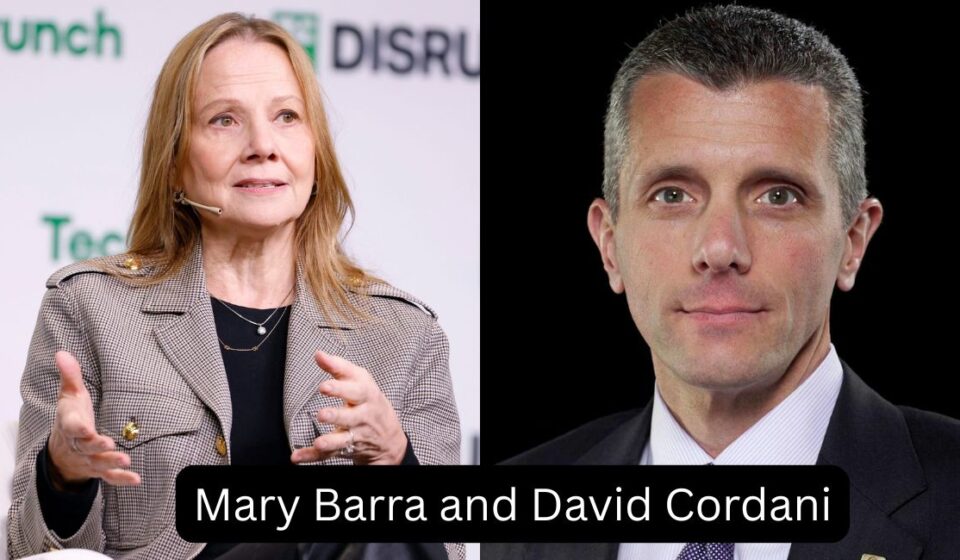

Mary Barra and David Cordani rank among the most watched executives in corporate America. Barra is chair and CEO of General Motors. Cordani led The Cigna Group for nearly 17 years and now serves as executive chair.
Their paths look different on paper. One started on a car factory floor. The other rose through insurance and health services. Yet both spent decades inside one company and steered it through heavy change.
This guide covers their backgrounds, key roles, shared traits, and biggest differences. You also get the latest 2026 updates, checked against company filings and recent news.
Quick Bio of Mary Barra and David Cordani
Mary Barra is 64 and leads GM, while David Cordani is 60 and chairs Cigna’s board as executive chair. Here is the profile summary, updated for October 2026.
| Detail | Mary Barra | David Cordani |
| Full name | Mary Teresa Barra (born Makela) | David M. Cordani |
| Age | 64 (born December 24, 1961) | 60 (born February 10, 1966) |
| Birthplace | Royal Oak, Michigan (some profiles list Waterford) | Waterbury, Connecticut |
| Height | Not publicly disclosed | Not publicly disclosed |
| Weight | Not publicly disclosed | Not publicly disclosed |
| Spouse | Tony Barra | Sherry Cordani (reportedly) |
| Children | Two adult children | Not publicly disclosed |
| Net worth | Not publicly disclosed (outside estimates vary widely) | Not publicly disclosed |
| Profession | Automotive executive | Health services executive |
| Education | BS in electrical engineering, Kettering University (formerly General Motors Institute); MBA, Stanford | Business degree, Texas A&M; MBA, University of Hartford |
| Current role | Chair and CEO, General Motors | Executive Chair, The Cigna Group |
| Company tenure | Since 1980 | Since 1991 |
| Social handles | Official handles not confirmed | Official handles not confirmed |
Anything marked “not publicly disclosed” has no reliable public source. Guessing would hurt trust, so it stays blank.
Mary Barra’s Early Career at General Motors
Mary Barra started at GM in 1980 as an 18 year old student working on the factory floor. She came in through the General Motors Institute, a school that mixed classes with paid work.
Her early tasks were hands on. She inspected fender panels and hoods as cars rolled off the line. Her father worked as a die maker at GM for about 39 years, so cars were part of her family life.
She earned her electrical engineering degree in 1985. GM then backed her Stanford MBA, which she finished in 1990. That mix matters. Barra understands both the assembly line and the boardroom.
Moving Through Different GM Roles
Barra held roles in engineering, plant management, communications, human resources, and product development before becoming CEO. That range is rare at the top of a global automaker.
Here is her path in order:
- 1980: Starts as a student worker at GM.
- 1999 to 2001: Serves as general director of internal communications for GM North America.
- 2003: Becomes plant manager at Detroit Hamtramck Assembly.
- 2004 to 2008: Leads vehicle manufacturing engineering as executive director.
- 2008 to 2009: Works as vice president of global manufacturing engineering.
- Around 2009 to 2011: Runs global human resources.
- 2011 to 2013: Moves up to lead global product development, later adding purchasing and supply chain.
- January 2014: Takes over as CEO.
- January 2016: Adds the chair title.
Each step gave her a new view of the business. Few executives touch the factory, the people side, and the product in one career.
Mary Barra and the Changing Auto Industry
Barra became CEO in January 2014 and faced a safety crisis almost at once. Ignition switch problems led to major recalls. She appeared before a congressional subcommittee in April 2014 and promised that GM would do the right thing.
That moment shaped her tone. Safety became her stated top priority, and she repeated that point in 2026 remarks tied to an Ad Council honor.
Then the industry shifted again. Barra pushed GM toward electric vehicles, software, and autonomous driving. GM also ended funding for its Cruise robotaxi unit in late 2024.
By 2026 the plan looks more flexible. Barra has said near term EV demand will run lower than GM planned. The company now aims for choice, with gas, hybrid, and electric options.
Here is where GM stands in 2026:
| GM 2026 Snapshot | Detail |
| Q2 revenue | $48.0 billion |
| Q2 adjusted earnings (EBIT) | About $3.9 billion |
| Full year guidance | Raised for the second time in 2026 |
| EV restructuring cash charges | Expected $7.2 billion, with $4.5 billion paid through Q2 |
| Tariff costs | Around $900 million per quarter |
| First half performance | Described by the company as its best ever |
| Software growth goal | About 1 million new subscriptions in 2026 |
GM’s next earnings report is scheduled for October 20, 2026. Watch it for fresh signals on trucks, EV losses, and tariffs.
David Cordani’s Career in Healthcare
David Cordani joined Cigna in 1991 and has spent about 35 years with the company. He grew up in Connecticut and studied business at Texas A&M. He later earned an MBA from the University of Hartford. Some profiles say he began as an auditor at Coopers & Lybrand in 1988. That detail comes from a secondary source, so treat it as reported, not confirmed.
Inside Cigna, he held several regional leadership roles. In 2008 he became president and chief operating officer. In late 2009 he became CEO and chairman. He also reportedly served on the boards of General Mills and ChildObesity180. Those outside seats added a consumer and public health angle to his work.
Building a Broader Healthcare Business
Cordani turned Cigna from a traditional insurer into a global health services company. The company’s own numbers show the scale of that change.
| Measure | When Cordani Started | By 2026 |
| Customers served | About 46 million | More than 185 million customer relationships |
| Annual revenue | About $18 billion | About $275 billion |
| Total shareholder return | Baseline | Up more than 750% |
Two moves drove much of that growth:
- The Express Scripts deal: Cigna bought the pharmacy benefit giant in 2018 for roughly $67 billion.
- The Evernorth brand: Cigna grouped its pharmacy, care, and data services under this health services arm.
The company says Cordani pushed programs that cut costs for customers and clients. Outside critics debate how well the industry as a whole handles affordability. Still, the growth record stands on its own.
David Cordani’s Leadership Transition in 2026
Cordani stepped down as CEO on July 1, 2026, and became executive chair of Cigna’s board. The company announced the plan on March 3, 2026.
Brian Evanko took the CEO seat. He had served as president and chief operating officer. He also worked as chief financial officer and as head of Cigna Healthcare during nearly three decades at the company.
Here is the timeline:
| Date | Event |
| February 25, 2026 | Board approves the succession plan |
| March 3, 2026 | Cigna announces Evanko as the next CEO |
| March to June 2026 | Cordani and Evanko work together during the handoff |
| July 1, 2026 | Evanko becomes CEO and joins the board; Cordani becomes executive chair |
Cordani described the move as a planned relay. His point was simple. A smooth handoff protects momentum.
The board agreed. Its lead independent director praised Cordani’s vision and said Evanko brought experience across every part of the business. Cigna also kept its 2026 outlook of at least $30.25 in adjusted earnings per share. This was a planned, multi year succession. That is the opposite of a sudden exit.
What Mary Barra and David Cordani Have in Common
Both leaders built their careers inside one company, learned many functions, and led through major industry shifts. That pattern is uncommon today. Most top executives hop between firms.
Both Developed Long Careers
Barra has spent about 46 years at GM, and Cordani about 35 years at Cigna. Neither one arrived as an outside fix. Both earned trust over decades.
Long tenure brings clear benefits:
- Deep company knowledge: They know how decisions play out on the ground.
- Strong internal credibility: Employees see leaders who earned their seats.
- Steady strategy: Plans can run across many years.
Both Gained Experience Across Business Functions
Neither leader stayed in one lane. Barra worked in plants, engineering, human resources, and product. Cordani rose through regional leadership, operations, and the top seat.
This breadth helps in a crisis. A leader who has seen several departments spots problems faster.
Both Led Through Industry Change
Each leader faced a business that looked very different from the one they started in. Barra dealt with recalls, EVs, software, and tariffs. Cordani dealt with a rising pharmacy business, a shift toward services, and constant pressure on health costs.
In both cases, the companies grew more complex. Their leaders had to widen the business without losing focus.
How Their Careers Differ
The biggest gaps sit in industry, education, and current titles. The table gives the quick view.
| Category | Mary Barra | David Cordani |
| Industry | Automotive | Health insurance and services |
| Starting point | Factory floor student worker | Corporate and finance track |
| Degree focus | Engineering plus MBA | Business plus MBA |
| CEO start | January 2014 | Late 2009 |
| 2026 role | Chair and CEO | Executive Chair |
| Company type | Manufacturer | Services and benefits |
Different Industries
Barra builds physical products, while Cordani built a services business. GM lives on factories, supply chains, and dealers. Cigna lives on contracts, networks, pharmacy services, and data.
That changes the daily pressure. Barra worries about parts, tariffs, and plant capacity. Cordani dealt with regulation, pricing, and care access.
Different Educational Backgrounds
Barra trained as an engineer, and Cordani trained in business. Both added an MBA later. That MBA gave each of them a shared language with investors and boards.
Her engineering base shows up in her focus on product quality. His business base shows up in his focus on portfolio and growth.
Different Leadership Positions in 2026
Barra still runs daily operations, and Cordani no longer does. She holds both the CEO and chair titles. He now guides the board while Evanko runs the company.
That is a major difference. Barra’s story is still unfolding at the top. Cordani’s story has entered a new chapter.
What Their Careers Reveal About Corporate Leadership
Their careers show that deep experience and careful planning still win at the top. Four lessons stand out:
- Learn the whole business. Wide exposure builds better judgment.
- Stay through change. Long tenure builds trust with staff and investors.
- Adapt the strategy. Barra shifted her EV plan as rules and demand changed.
- Plan the handoff. Cigna’s multi year succession reduced risk.
Another point matters for readers. Neither leader had a straight path. Both took on hard assignments, from plant management to regional leadership, long before the top job.
Boards also watch these patterns. Insiders with proven results often earn the biggest roles.
Mary Barra and David Cordani in 2026
In 2026, Barra is pushing GM’s profit story, and Cordani is guiding Cigna from the board. Both stories offer news to track.
For Barra:
- GM posted record first half results and raised its full year outlook.
- The company is trimming EV losses while building more trucks and SUVs.
- She will receive the Ad Council’s Public Service Award on December 3, 2026.
- In a September 2026 interview, she signaled she still has more to give.
For Cordani:
- He moved to executive chair on July 1, 2026.
- He remains tied to Cigna’s strategy during the handoff to Evanko.
- His record is now measured by how well the company performs under new leadership.
Check company filings and earnings calls for updates. Titles and numbers can change quickly.
Fast Facts About Mary Barra and David Cordani
- Mary Barra is chair and CEO of General Motors.
- She joined GM in 1980 at age 18.
- She became CEO in January 2014 and chair in 2016.
- She studied electrical engineering and earned a Stanford MBA.
- David Cordani joined Cigna in 1991.
- He served as CEO from late 2009 until July 1, 2026.
- He is now executive chair of The Cigna Group.
- Brian Evanko succeeded him as CEO.
- Cigna grew from about $18 billion to about $275 billion in annual revenue under Cordani.
- GM raised its 2026 guidance twice and reports next on October 20, 2026.
FAQs
Who is the CEO of General Motors in 2026?
Mary Barra is the chair and CEO of General Motors. She has held the CEO role since January 2014.
Is David Cordani still the CEO of Cigna?
No. He stepped down as CEO on July 1, 2026, and now serves as executive chair of the board.
Who replaced David Cordani at Cigna?
Brian Evanko took over as CEO on July 1, 2026. He previously served as president and chief operating officer.
How long has Mary Barra led GM?
Over 12 years. She became CEO in January 2014 and added the chair role in January 2016.
What did Mary Barra study?
She earned an electrical engineering degree from Kettering University (formerly General Motors Institute) in 1985. She then completed a Stanford MBA in 1990.
Final Thoughts
Mary Barra and David Cordani took different roads to the top. She came up through plants, product, and people roles at a carmaker. He climbed through a health company and reshaped it into a global services giant.
Yet their stories share a clear thread. Both stayed with one company, learned many functions, and led through big shifts.
Barra now steers GM through tariffs, EV changes, and a push into software. Cordani has moved into an executive chair role after a planned handoff to Brian Evanko.
If you follow business leadership, watch both. Their results will keep shaping how Americans view the auto and health industries.

Wellcome to celebbeacon, I am professional content witer with 3 years of experience.