Checking the clock and wondering how long until 5:30 is one of the most common time questions people search every single day.
Whether you’re counting down to the end of a work shift, waiting for a flight, or just eager for a scheduled event, this guide breaks down the exact method to calculate it in seconds. No app needed, no confusing math, just a simple system anyone can use.
Quick Answer Summary Table
| Detail | Information |
| Topic | Calculating time remaining until 5:30 |
| Method used | Base 60 bridge method |
| Applies to | 5:30 AM and 5:30 PM |
| Skill level | Beginner friendly |
| Tools needed | None (mental math works) |
| Common uses | Work shifts, appointments, flights, deadlines |
| Time zone sensitive | Yes, always confirm local time |
| Average calculation time | Under 10 seconds |
Why People Constantly Ask “How Long Until 5:30”
The question feels small, but it carries real weight. 5:30 often marks a boundary point in daily life. It’s the classic end of a nine to five workday, a common dinner time, a frequent flight departure slot, or the moment a favorite show starts. When your mind fixates on a target time, minutes seem to move slower than they actually do.
This isn’t just a feeling. Researchers who study time perception note that waiting periods feel longer when we actively monitor them. The more you glance at the clock, the more stretched out those final minutes seem. Knowing exactly how much time remains actually reduces that anxious clock watching, because your brain stops guessing and starts counting down with certainty.
The Simple Math Behind Time Calculations
Most people struggle with time math because they try to treat it like regular subtraction. Clocks don’t work in base 10, they work in base 60. That single fact trips up more people than anything else.
Here’s the core idea: an hour holds 60 minutes, not 100. So when you subtract times, you can’t just borrow the way you would with dollars and cents.
The Bridge Method Explained
The easiest trick professionals use is called the bridge method. Instead of subtracting the full time in one messy step, you break the gap into two clean chunks.
Follow these steps:
- Find the next whole hour from your current time.
- Count the minutes it takes to reach that hour.
- Add the remaining full hours from that point to 5:30.
- Combine both numbers for your final answer.
Example Walkthrough
Let’s say it’s currently 2:42 PM and you want to know how long until 5:30 PM.
- From 2:42 PM to 3:00 PM is 18 minutes.
- From 3:00 PM to 5:30 PM is 2 hours and 30 minutes.
- Add them together: 2 hours, 30 minutes, plus 18 minutes equals 2 hours and 48 minutes.
That’s it. No calculator required, and the bridge method removes the confusing “carry the one” problem that trips people up with 60 minute boundaries.
Time Difference Chart for 5:30
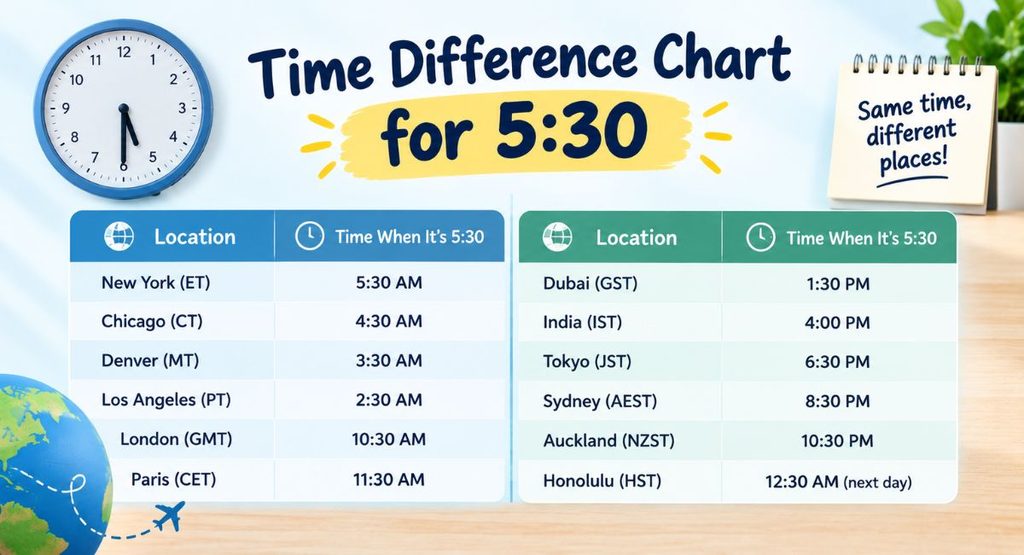
Use this quick reference table to check common starting points and how much time remains until 5:30.
| Current Time | Time Until 5:30 |
| 1:00 | 4 hours 30 minutes |
| 2:00 | 3 hours 30 minutes |
| 2:30 | 3 hours |
| 3:00 | 2 hours 30 minutes |
| 3:45 | 1 hour 45 minutes |
| 4:00 | 1 hour 30 minutes |
| 4:15 | 1 hour 15 minutes |
| 4:30 | 1 hour |
| 5:00 | 30 minutes |
| 5:15 | 15 minutes |
This table works whether you’re tracking 5:30 AM or 5:30 PM. Just apply it to whichever half of the day matches your situation.
AM or PM: Does It Change the Calculation?
The math itself stays identical whether you’re counting toward 5:30 AM or 5:30 PM. The only thing that changes is context. Someone tracking 5:30 AM is likely an early riser preparing for a commute, a workout, or a flight. Someone tracking 5:30 PM is usually closing out a workday or heading toward an evening plan.
One small trap to avoid: if it’s currently late at night, say 11:00 PM, and your target is 5:30 AM, you’re crossing midnight. In that case, count the hours until midnight first, then add the hours from midnight to 5:30 AM.
For example, from 11:00 PM to midnight is 1 hour. From midnight to 5:30 AM is 5 hours and 30 minutes. Total time remaining equals 6 hours and 30 minutes.
Read This: How Long Until 1:30? A Complete Time Calculation Guide
Why Time Zones Matter for This Calculation
A search like “how long until 5:30” doesn’t automatically specify location, and that matters more than people assume. 5:30 in New York is not 5:30 in Los Angeles. Time zones shift the target based on where you and the event are physically located.
Here’s a simple breakdown of how a single moment translates across regions:
- If it’s 2:30 PM UTC, it becomes 3:30 PM in London.
- That same moment is 9:30 AM in New York.
- Meanwhile, it reads as 11:30 PM in Tokyo.
So if your goal is 5:30 PM local time in your own city, you don’t need to worry about zones at all. But if you’re coordinating a call, meeting, or flight involving another region, always confirm which time zone the 5:30 refers to before calculating.
Daylight Saving Time Adjustments
Daylight Saving Time (DST) can quietly throw off your math twice a year. When clocks move forward or backward, the actual gap between now and 5:30 shifts by an hour, even though your phone or watch adjusts automatically. If you’re doing manual calculations during a DST transition week, double check whether your device already applied the shift, or you might end up an hour off in either direction.
Everyday Situations Where This Question Comes Up
Knowing how long until 5:30 helps in more scenarios than people initially realize. Some of the most common include:
- Wrapping up a work shift and planning the commute home
- Catching a flight with a boarding or departure time set at 5:30
- Cooking a meal that needs to finish by a specific dinner time
- Meeting friends or family for an event starting at 5:30
- Managing kids’ schedules, like pickup times or activity start times
- Tracking medication timing that follows a strict clock based routine
- Studying or working against a deadline set for the end of the day
Each of these situations benefits from quick, accurate mental math rather than pulling out a countdown app every time.
The Psychology of Waiting for a Specific Time
There’s an interesting mental pattern behind why the final stretch before 5:30 always feels the longest. Studies on time perception suggest that waiting periods feel passive, while working toward a task feels active. That’s why the last 20 minutes of a shift can feel longer than the previous three hours combined.
Digital clocks can actually make this worse. Because they show a static number instead of a moving hand, digital displays remove the spatial sense of progress that analog clocks provide. Watching a digital clock tick from 5:12 to 5:13 doesn’t convey motion the way a sweeping second hand does, which can heighten that anxious, stretched out feeling.
A simple fix: instead of staring at the clock, set a single timer for the exact remaining duration and put the device away. Removing the repeated clock checks reduces the perceived length of the wait significantly.
Manual Calculation vs Digital Tools
You don’t need an app to figure out how long until 5:30, but digital tools do offer convenience in certain situations.
| Method | Best For | Speed | Accuracy |
| Mental math (bridge method) | Quick daily checks | Instant | High with practice |
| Physical clock or watch | Visual learners | Fast | High |
| Phone countdown timer | Hands free tracking | Instant setup | Very high |
| Calendar app reminder | Recurring events | Setup required | Very high |
For a one time quick check, mental math wins every time. For recurring situations, like a daily 5:30 shift end, a saved timer or alarm removes the guesswork completely.
Common Mistakes People Make
Even simple time math trips people up more often than expected. Watch out for these common errors:
- Forgetting AM versus PM, especially near midnight or noon
- Subtracting minutes like regular numbers, ignoring the 60 minute cycle
- Skipping the time zone check during multi region coordination
- Not accounting for Daylight Saving Time during transition weeks
- Miscounting across midnight when the target time falls in the early morning
Slowing down for just a few extra seconds to double check these details prevents most calculation errors.
Final Thoughts
Figuring out how long until 5:30 doesn’t require any special tools, just a clear grasp of the bridge method and a quick awareness of time zones or Daylight Saving shifts when they apply.
Whether you’re closing out a workday, catching a flight, or counting down to dinner, this simple mental math trick gets you an accurate answer in seconds. Keep the reference table handy, and you’ll never have to second guess the countdown again.
Frequently Asked Questions
How do I calculate how long until 5:30 without a calculator?
Use the bridge method. Count the minutes to the next full hour first, then add the remaining hours to 5:30, and combine both numbers.
Does the answer change between 5:30 AM and 5:30 PM?
No, the math stays the same either way. Only the context of your day changes, along with the possibility of crossing midnight depending on your starting point.
Why does waiting for 5:30 feel longer than it actually is?
Time perception research shows that actively monitoring a countdown makes waiting feel slower, since passive waiting registers differently in the brain than active tasks.
Do time zones affect how long until 5:30 it is?
Yes, since 5:30 in one region can be several hours different in another, always confirm which local time zone your target refers to.
What is the fastest way to track this if I need it daily?
Set a recurring alarm or countdown timer on your phone for 5:30. This removes the need for repeated manual math every day.

Wellcome to celebbeacon, I am professional content witer with 3 years of experience.